
The Frontier
It’s one thing to let a friend down. It’s another thing to betray them.

Universalist am I
And dream a world that's frontier free,
With common tongue and common tie,
Uncurst by nationality;
Where colour, creed and class are one,
And lowly folk are lifted high;
Where every breed beneath the sun
 Is equal in God's eye.
~  From My Trinity by Robert W. Service
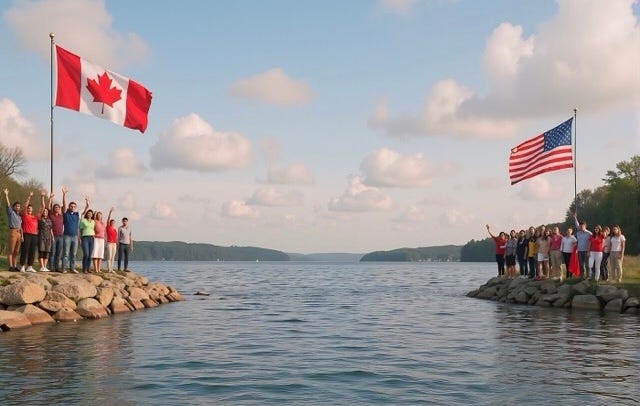
Campobello Island, New Brunswick lies at the easternmost point of the longest undefended border in the world. Across “the narrows” is Lubec, Maine, the first place in the United States where the sun rises. Mainers call it “downeast.” Lubec is as downeast as it comes.
The Canadian island and the U.S. mainland are connected by the Franklin Delano Roosevelt Memorial Bridge. Visiting the area is to step back in time. A time of unwavering connection and trust between the two countries. Locals, many of whom are dual citizens, continue to celebrate the international bond that’s also so deeply personal.
Roosevelt Campobello International Park
Roosevelt Campobello International Park, co-founded in 1964, is administered by a joint Canadian and American Commission and financed and staffed equally. It is the only international park of its kind in the world.
The Park celebrates Canadian-American cooperation and friendship. The Visitor Centre cites “extensive social, economic, military, cultural ties” along with a “legacy of friendship, based on trust, affection and mutual respect…”
FDR’s words on the Visitor Centre plaque read:
I give to you assurance that the people of the United States will not stand idly by if domination of Canadian soil is threatened by any other empire.
Kingston, Ontario, 1938
Tea with Eleanor
The Island became a popular summer retreat for well-to-do Canadians and Americans in the 1880s, including FDR’s parents. His mother gave Franklin and Eleanor a house on the Island as a wedding gift. They were not part of your typical well-healed summer crowd.
FDR spent virtually every summer on Campobello Island from age one until he came down with polio in the summer of 1921. He and Eleanor were intimately involved in life on the Island.
As a boy, he developed a strong relationship with Tomah Joseph, a Passamaquoddy tribal elder. Joseph schooled FDR in how to navigate the tides of Passamaquoddy Bay in a birchbark canoe. This was no small feat as Passamaquoddy Bay, an inlet of the Bay of Fundy, is known for treacherous currents and whirlpools.*
Eleanor went on long walks every morning. She enjoyed tea each afternoon and invited those she met on walks to afternoon tea. Teas were entirely egalitarian, everyone was welcomed and invitations were coveted.
The tradition of “Tea with Eleanor” endures, now as part of the Park experience. Spending a few days in Lubec in August, 2025, people on both sides of the border asked us, “So, did you have tea with Eleanor yet?” We did not, only because all spaces were already reserved. We did visit the local watering hole where we shared a high top and a local brew with a lobstering couple. Their first question was, “Have you had tea with Eleanor?” We did the next best thing.
The Rest of the Frontier
From Lubec, the border stretches west for 5,525 miles or 8,892 kilometers, principally along the 49th parallel. There are no walls or fences. There are a few thousand old border markings in the wilds. And over 100 official land crossings, 24 in Maine alone.
There are 21 bridges or tunnel crossings. The Ambassador Bridge connecting Detroit and Windsor, Ontario is the busiest international border crossing in North America, supporting 25% of U.S. - Canadian trade and 150,000 jobs. The shortest bridge is 32 feet connecting two islands in the St. Lawrence River, one American and one Canadian. There is even a two-lane street that straddles the border between Stanstead, Canada and Derby Line, USA.
The Bottom Falls Out
In 2024, the U.S. and Canada were each others’ principal trading partners. Then the bottom fell out in February, 2025 when the U.S. implemented punishing tariffs which, coupled with threats to annex Canada, upended the relationship. Canadian boycotts of American goods ensued and commerce and tourism have been broadly impacted. Both countries have suffered. But the harm is not just about trade or economics.
In July, 2025, the PBS NewsHour aired a segment on Canadian tourism to the U.S. The lead-in cites the fact that more Canadian tourists visit the U.S. than from any other country. And that in 2024, Canadians made over 20 million visits to the U.S. and spent over $20 billion.
The NewsHour segment touched on personal feelings and hurt on both sides of the border. Here are a few examples:
Julie Morrison, Canadian with close U.S. ties: This threat of annexation by this very powerful militarized ally, we took it very, very seriously. And, honestly, it’s frightening. My family has owned property in Vermont all my life. I learned to ski in Vermont when I was like 3 years old. We hiked the Long Trail. I mean, it's so beautiful. The process of selling this property for my entire family has been extremely difficult emotionally. It's almost like we have to mourn this moment.
Harold White, Canadian Tourist: And I have many U.S. friends, American friends that I will not be seeing in person for a while because of this. But that’s c’est la vie, as we say here in Quebec.
Steve Wright, Manager of Jay Peak Resort in Vermont: My dad is Canadian. . . I called 100 households myself, Canadian households who had purchased season passes last year by this point who have not yet purchased. . . And to a household, they referred back to the 51st state narrative as being emblematic of the reason that they're not coming.
Mike Donahue, Business Owner in Burlington, Vermont: Church Street, which is the pedestrian market, is being renamed through Canada or Canada Street to show our solidarity with our Canadian neighbors.
The U.S. President referred to the border with Canada as an “artificially drawn line,” as if to rationalize breaching prior agreements and to justify threats to sovereignty.
The border represents trust between two neighboring countries with a longstanding friendship. It is one thing to let a friend down. It’s another to betray them.
Relationships, like so many other things, are more easily destroyed than built. This national nightmare will come to an end. And when it does, repairing this relationship and so many others will require humility.
FDR was a skilled mariner and years later as Assistant Secretary of the Navy piloted Navy destroyers through the Lubec Narrows.
Yes!
Cyd